Home Presses Intro Site Map P.R. Chemicals Answers Secure Shopping Cart
Prices Specials How To Bullets B.Makers Books Classified
Topics Jackets Terms Training Software Products Contact us

Home Page

Figuring Out What You Need...
Dave Corbin, CEO Dave Corbin, CEO/Founder
Corbin Manufacturing & Supply, Inc.


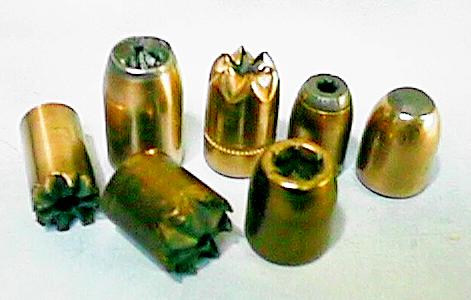
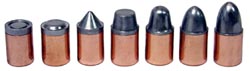
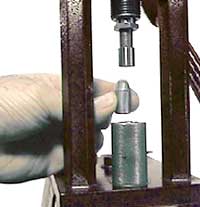
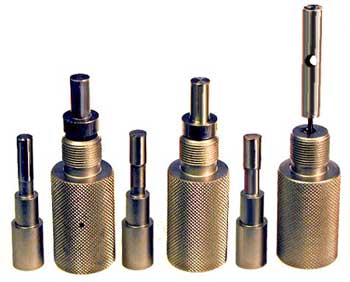
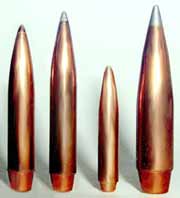
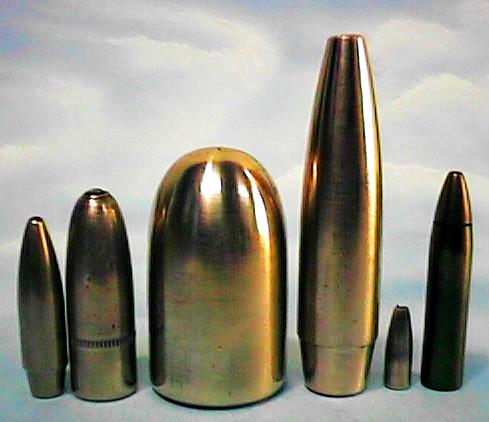
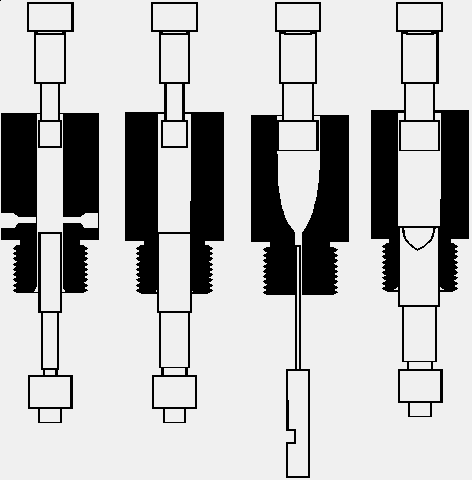
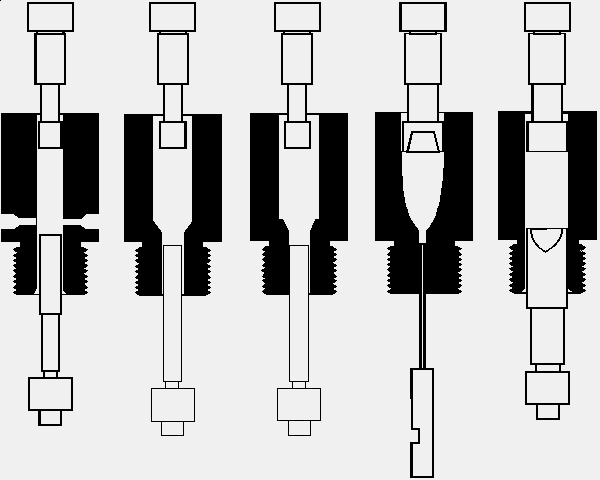
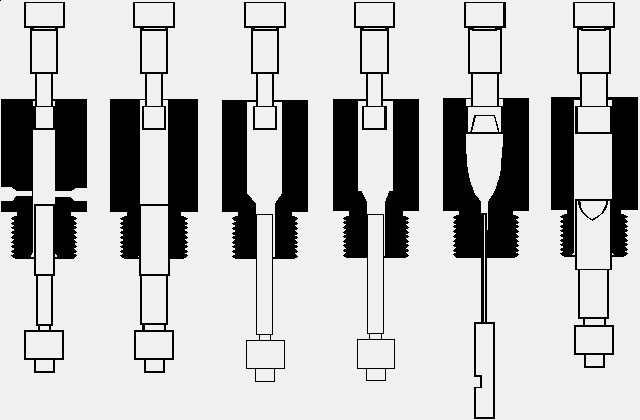
Illustrated Bullet Types and Tools to Make ThemSelect by Bullet Type
Starting Package for Typical Bullet DesignsStarting Setup
Step by step instructions for swagingDie Instructions
All about bullet jacketsBullet Jackets
Bullet Swaging Terminology and Catalog Number MeaningsWhat does it mean?

Greetings!

I'm Dave Corbin. Let's talk about the tools you need to make any kind of bullet you want. Most open tip, flat base bullets can be made with the CSP-1 press and the FJFB-3-S 3-die set, a bottle of swage lube (CSL-2), a bag of jackets (or a jacket making kit), a roll of lead wire (or a core mould), and a core cutter (if you use lead wire). Add a RBT-2 Rebated Boattail set for rebated boattail base, and a LT-1 lead tip die for lead tips. Each "set" of dies is made from combinations like this. They are all based on the FJFB-3- 3-die set, except for those which can be made in a semi-wadcutter style (LSWC-1) die.

Click for complete package quoteClick for complete swaging package quotes.
This is a very large web site, covering the tools and ideas we've developed in more than two decades of leadership in the field of bullet swaging. The tools you need for any one design of bullet are simple to figure out and use. But we have developed so many different kinds of tools and new bullets that may seem complicated or confusing at first. You only need a tiny portion of all the different products, in order to produce any given bullet. It isn't difficult, once you begin to grasp the basic concepts.

In order to help you quickly decide what you need, first decide on these three things:
  1. What caliber do you want to make?

  2. What style of bullet is desired?

  3. What materials do you plan to use?

CALIBER RANGE

If you choose a caliber from .123 to .458, it means you can, if you wish, use the type -S dies which fit current S-Press, provided nothing else gets in the way (such as material hardness, length or design of the bullet). Type -S dies are 1-inch O.D. They have a 5/8-24 threaded shank to fit the CSP-1 ram. (Swage dies go into the press ram, and the press head holds a floating alignment punch holder). Turning a 5/8-inch diameter shank on the die leaves 3/8-inch shoulder for support of thrust, which takes all the pressure off the threads. The punches do their work inside the 1-inch diameter portion of the die, so the shank does not have internal pressure during swaging.

If you choose a caliber larger than .458, then the die needs to be larger to hold the pressure, which can exceed 50,000 psi with relatively soft lead alloys and go much higher with harder alloys. In that case, the type -H die system (which fits the CSP-2 Mega Mite, CSP-2H Hydro Junior or CHP-1 Hydro Press) is used.

The first thing nearly everyone wants to know is, can I use my reloading press to swage bullets? The answer is yes, certain bullets. But reloading presses are NOT the same as swaging presses. Even the toughest reloading presses (including those "made for swaging bullets") are not designed so the die goes into the ram with self ejection on the down stroke. None of them have bearings or hardened tool steel rams (Corbin presses use high quality bearings in the links, and guide the ram with precision honed bearings, and use hardened and ground rams). A Corbin press has a floating alignment system, like a CNC lathe, which puts the punch directly and positively into perfect alignment with the axis of the bullet, another feature missing on reloading presses. And finally, reloading presses do not let you drop the components easily into the die, since the loading press uses a die that fits the press head and is "upside down" for swaging.

Combine all these factors with the 200% increased power and 500% increased strength of Corbin's presses, with their hardened and ground alloy steel rams, and you can see that a reloading press is not as good a choice for swaging as an actual press designed around the process, with dies that do not have to compromise their design to work around a reloading function.

Still, in cases where you don't need the ultimate accuracy, fast production, or ability to continue adding features and making the more exotic designs, you can make bullets with soft lead (with or without jackets) using your sturdy RCBS-type slotted shellholder ram reloading press with 7/8-14 threaded press head.

See the price list under "reloading press dies" for a complete listing of Pro-Swage and BSD-xxx-R dies. Any Corbin product ending with -R will work in a reloading press.

Most people find the Corbin CSP-1 S-Press (all steel roller bearing) press to be exactly what they need. Together with the type -S dies, it can handle any caliber from .123 to .458, with lead or jacketed bullets, and material hardness up to Bhn 8-10 (sometimes as much as 12 depending on the bullet shape and diameter).

Top of page

MATERIAL

If you want to make any bullet using a material hardness greater than 10 Bhn, your best choice is the -H system. We offer both a large hand powered press (the CSP-2 Mega Mite) and two power presses (CSP-2H Hydro Junior and CHP-1 Hydro Press) for these 1.5-inch diameter dies and their long heavy punches.

If the material is tungsten powder, plastic or similar materials, generally it can be swaged with the -S dies. If it is solid copper, brass, aluminum, or uses steel tubing for jackets, then the -H dies are more suitable. There are specific techniques required to swage solid rod into bullets (you cannot use exactly the same processes and tools as for soft lead and/or jacketed bullets with solid materials, as the pressures skyrocket beyond 100,000 psi unless certain techniques are used). However, solid copper or brass bullets can be swaged using the right tools and technique.

Here are some general guidelines:

    Bhn 5 SOFT LEAD OR MATERIAL WITH SIMILAR PRESSURE/FLOW RATE ONLY
  • Type -R dies (standard Corbin ogives and calibers only)
  • Type -M dies (.12 to .458 caliber, any standard Corbin ogive)
  • Type -S dies (.12 to .458 caliber, any standard or custom ogive)
  • Type -H dies (.224 to .998 caliber, any practical length ogive)
    Bhn 6-10 OR MATERIAL WITH SIMILAR PRESSURE/FLOW RATE ONLY
  • Type -S dies (.12 to .358 caliber, or up to .458 with ogive 4-S or less)
  • Type -H dies (.224 to .458, or up to .600 with ogive 4-S or less)
    Bhn 11-12 OR MATERIAL WITH SIMILAR PRESSURE/FLOW RATE ONLY
  • Type -S dies, calibers under .40 with ogive 1-E or under
  • Type -H dies, calibers under .600 with ogive under 8-s, non-RBT
    Bhn 13-20 OR MATERIAL WITH SIMILAR PRESSURE/FLOW RATE ONLY
  • Type -H dies, calibers under .600 with ogives 1-E or less, drilled axial relief hole.

Top of page

Style and Design

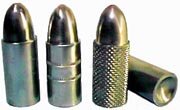
Semi-Wadcutters: TWC, BWC, Conical, Keith, AL, 3/4-E, 1-E shapes Nearly any soft lead bullet can be swaged in LSWC-1-S or LSWC-1-H lead semi-wadcutter die, if you don't mind having a little .015 shoulder between the nose and the bullet shank (necessary because with this simple die, the nose is formed in a punch cavity and the edge of the punch needs to be about that thick to avoid breakage). The actual cavity shape isn't critical, as long as it does not exceed about one caliber in length and has a releasing taper (a parallel sided cylindrical nose would tend to stick in such a punch cavity, but fortunately hardly anyone wants that shape on a bullet nose!).

The base shape is also formed against a punch, so as long as you take the edge of the punch into consideration (in other words, don't specify a bevel base bullet when you know that the punch edge itself has to form a .015 step before you ever get to this bevel shaped cavity), then the single LSWC-1 die does the whole job in one stroke.

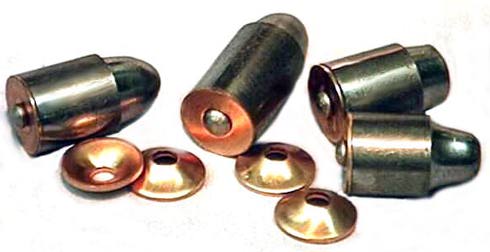
If you want to use a gas check, or the far better Base Guard(TM), hollow, cup, dish, rebated boattail or flat base on the lead bullet, that is done simply by specifying a base punch with that shape. If you want a heel base bullet, that is done in a die called a DDS-1 dual diameter die. These are all detailed on our other web pages and shown in the price list.

The LSWC-1 die comes with one nose, and one base, of standard design (those we stock). If you want a punch made to your specifications, there is a custom tooling fee, but it is quite reasonable since we do it so frequently. Just remember that any punch that forms part of the bullet in a cavity must have about .015 inches of square end on the edge, or else it will crumble and break under the extreme pressures.

The WEIGHT of the bullet isn't terribly important to the die you choose, since all the dies make a wide range of weights simply by adjustment of the punch holder. It is good to let us know the range of weights you want to make, or the weight you are most interested in, because we can test and optimize the punch dimensions for it. And we can also determine if the die will hold that much material, and if not, suggest a larger system that will work.

Note that there is really no difference in the basic design of the tools whether you want to make an airgun pellet or a shotgun slug, or any kind of lead handgun bullet or paper patch rifle bullet, in this general category of style. We just make the hole a different size in the die, and use a die body that is appropriate for the length and diameter of that hole, fit the right punches to it, and provide it with a press that is large enough to handle the required stroke and pressure. Other than that, the same exact technique and ideas and drawings would apply. You just change the nose and base shape to suit your desire.

For our purposes, there are two broad categories of jacketed bullets. There is the semi-wadcutter style and the full jacket style. These are not specific shapes, but only general categories that help us determine whether you can make the bullet in a two-die set or a three-die set.

A two-die set first swages a lead core or cylinder, of a size that slips easily into a jacket. Then the second die pushes the lead down into the jacket and forms the nose, all at once. The nose must be entirely lead, and it must be long enough so that the end of the nose punch does not hit the end of the jacket (or else it would wrinkle and crush the jacket).

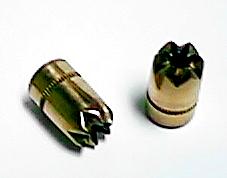
Whether the nose itself is round, Keith, full wadcutter, a big hollow cavity, or some other special form like our Saber Tooth design, does not matter. That is just the selection of a different nose punch. Likewise, you can use this two-die set to make a lead, gas check, half jacket, 3/4-jacket or Base Guard bullet. (You cannot use it to bring the jacket past the full diameter and into the nose area.) This kind of bullet is typically a jacketed wadcutter or semi-wadcutter. We refer to the general style as a SWC because we have to call it something.

The base can be flat, cupped, dished, hollow, or almost anything else so long as you take into consideration that it is formed by pressing against a punch, and the punch cannot have a cavity with zero thickness edge.

A full jacket set doesn't necessarily mean you have to make a FMJ bullet in it. Whenever you want to curve any part of the bullet, or bevel it smoothly without a step, you need the FJFB-3 3-die set. The first die, called a core swage, forms the lead core and extrudes away any surplus weight (gets rid of variations). The second die, called a core seater, seats the lead into the jacket (if you use a jacket). The third die is a semi-blind cavity die called the point former. The PF die has the curvature that you want formed in its cavity. At the tip is an ejection pin to push the bullet back out by the nose.

If you push a lead slug into this die, it comes out looking just like the cavity: a lead bullet without a step or shoulder. You can skip the second die (CS or core seater) if you want smooth ogive lead bullets for handgun or rifle. If you want a jacketed bullet with a soft point, hollow point, or open tip, you would use the first two dies to prepare a cylindrical jacketed slug. Depending on the amount of lead you want exposed, or the amount of open tip area or kind of hollow cavity you want, you would use an appropriate shape and diameter of punch to just fit inside the jacket mouth and push the lead down, or to shape a conical cavity into the lead as you seat it. If you want to make a large lead tip, the punch used to seat the lead core into the jacket would be made to fit the CS die diameter, instead of fitting down into the jacket.

Pushing the jacketed cylindrical slug into the point form die shapes the nose curve on the bullet. You can push it a little way in, and make a large tip, or push it all the way and close the tip to the maximum possible amount. The smallest tip opening is the size of the ejection pin in the die. Special techniques or a follow-up LT-1 lead tip die can help close this tip down all the way.

To make purchasing easier, we package the two and three die sets in matching kits called the JSWC-2 and the FJFB-3. There is a -M, -S, or -H following the catalog number, which indicates the size and thread type of the die. -M is for the discontinued Silver Press or the S-Press, and has a 3/4-inch body die with 5/8-24 shank. The -S is for the S-Press and has a 1-inch body die with 5/8-24 shank. The -H dies fit the CSP-2 Mega Mite press or the large hydraulic presses, and have a 1.5-inch body with 1-20 threads. The punches for the -H dies are nearly as large as the rams on the S-Press. You cannot interchange dies in the presses except as indicated (-M fits the Series II, as does the -S).

All the other die sets, such as the LTFB-4 or RBTO-4 four and FRBO-5 or RBTL-5 five and FRBL-6 six die packages, just add either a lead tip forming die or a rebated boattail forming die/punch package to the 3-die set. The 3-die set is the basis for nearly any bullet you want to make that has a jacket or a smooth curved ogive or beveled base.

Top of page

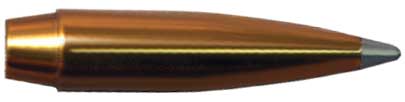
6-S ogive rifle bullet
TC ogive pistol bullet

Popular Packages

Here is the most commonly purchased package for jacketed rifle or pistol bullets:

  • CSP-1 S-Press
  • CSP-B Bench Stand for press
  • FJFB-3-S die set (specify caliber, base, and nose shapes)
      Examples:
    • .224 cal. FB 6-S ogive
    • .243 cal. FB ULD ogive
    • .308 cal. FB 6-S ogive
    • .357 cal. CB TC ogive
    • .452 cal. CB 3/4-E ogive
    • .458 cal. CB 1-E ogive
  • CSL-2 swage lube (required)
  • LW-10 lead wire
  • PCS-1 core cutter
  • Bullet jackets (250 or 500, typical)
  • HCT-1 hand cannelure tool

RBT, lead tip made in RBTL-5 die set

Here is the second most commonly purchased package, for long range rifle bullets:

  • CSP-1 S-Press
  • CSP-B Bench Stand for press
  • RBTL-5-S die set (specify caliber, and nose shapes)
      Examples:
    • .224 cal. RBT 6-S ogive
    • .243 cal. RBT 6-S ogive
    • .284 cal. RBT ULD ogive
    • .308 cal. RBT ULD ogive
  • CSL-2 swage lube (required)
  • LW-10 lead wire
  • PCS-1 core cutter
  • Bullet jackets (250-500 typical)

lead bullet made in LSWC-1 die

This is a very popular package for making full-bore lead or paper patched bullets:

  • CSP-1 S-Press
  • CSP-B Bench Stand for press
  • LSWC-1-S die set (specify caliber, and nose shapes)
      Examples:
    • .366 for .38-55 cal. pp CB 1-E ogive
    • .448 for .47-70 cal. pp CB 1-E ogive
    • .392 for .40 cal. pp CB 1-E ogive
  • CSL-2 swage lube (required)
  • LW-10 lead wire
  • PCS-2 core cutter (wire over .365-in)
  • Optional for full-bore: HCT-2 knurling tool or HCT-3 grooving tool

3/4-E SWC made in JSWC-2 set

Jacketed SWC-style bullets are made in two steps with this package:

  • CSP-1 S-Press
  • CSP-B Bench Stand for press
  • JSWC-2-S die set (specify caliber, and nose shapes)
      Examples:
    • .355 for 9mm, .380, or 38 Super FB AL ogive
    • .429 for .44 Mag, .44 Spl. FB Keith ogive
    • .452 for .454 Casull, .45 ACP FB 3/4-E ogive
  • CSL-2 swage lube (required)
  • LW-10 lead wire
  • PCS-2 core cutter (wire over .365-in)
  • Bullet Jackets (250 or 500 typical)

To go into production, use hard lead, make calibers larger than .458 or longer than about 1.2 inches OAL, or do certain other somewhat exotic things that might take longer stroke or more pressure than the hand press dies can sustain, get one of the larger presses (CSP-2, CSP-2H, or CHP-1) and a set of -H dies. Over 90% of the custom bullet making firms in the world (22 countries) use the CHP-1 press because it is so versatile and cost effective compared to any alternative system.

To make bullet jackets from copper tubing (excellent hunting bullets, good target bullets), get a CTJM-1 tubing jacket maker kit for the appropriate caliber, a SAW-1 tubing cutter saw and a supply of the appropriate size tubing. We need to know what jacket you plan to use, because the size of the core seating punch and the core swage die diameter as well as diameter of lead wire you use all depend on jacket wall thickness.

To draw copper strip into jackets, this can be done on a hand press for most handgun jackets and the shorter rifle jackets (224 and 243 caliber under .7 inches, for example). If the length exceeds about .5 to .7 inches, then a hydraulic power press is a necessity. The JMK-1 basic system uses separate hand fed blanking and cupping dies, and the more automated JMK-2 system uses an automatic strip feed with lubricator in a special head that blanks and cups in one stroke. This would be the method for virtually any caliber, length, wall thickness, or taper of jacket wall from .17 to .458. Larger caliber jacketed bullets generally use tubing. Also, very thick walls (.040 and more) are more economically made using thick wall tubing than strip.

Rather than figure all this out yourself, let us know where you plan to go with your swaging, and what you already have now (if anything). We can help you plan so that there is no unnecessary purchase. Sometimes, you may want a spare die or punch, if you plan a business in custom bullet making. It is wise to have spares when your income would depend on getting the products out even if you broke or lost one of the parts. Some items (mostly punches) can be quickly replaced; others such as point forming dies are time consuming to make and require so much production machinery and manpower that they have to be scheduled around the existing backlogs. I am glad to advise customers on what I would want for spares and what really isn't necessary as long as we have over-night delivery services.

Dave Corbin The best way to get exactly the right tools is to write down what you want to make, and see if you can tell from the publications and web pages exactly what you need. If not, send us a list of the bullets you want to make, along with any extra features like cannelures, bonded cores, tungsten or plastic fillings, Saber Tooth noses or whatever else you desire to add to the basic bullet design. We can get back to you by e-mail, fax, or printed quote with the exact list of items to do the job right.

-- Dave Corbin,
CEO

Top of page


Home Page Price List E-Mail Sales Bullet Design New Products Q&A Terminology
Retirement Specials Topics Software How to swage Classified Ads Feedback