| Home | Presses | Intro | Site Map | P.R. | Chemicals | Answers |

|
| Prices | Specials | How To | Bullets | B.Makers | Books | Classified | |
| Topics | Jackets | Terms | Training | Software | Products | Contact us |
| Home | Presses | Intro | Site Map | P.R. | Chemicals | Answers |
|
| Prices | Specials | How To | Bullets | B.Makers | Books | Classified | |
| Topics | Jackets | Terms | Training | Software | Products | Contact us |

 > Pro-Swage Kit > RFJM Jacket Maker > How to Swage 224 Bullets > Pro-Swage Kit > RFJM Jacket Maker > How to Swage 224 Bullets
|
|
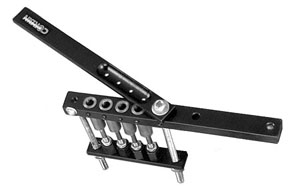
KIT-224R for your reloading press, and... KIT-224S for the Corbin S-press (CSP-1). |
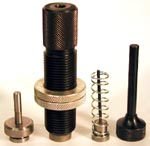
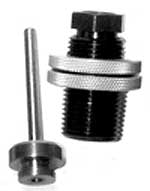 The KIT-224R includes:
|
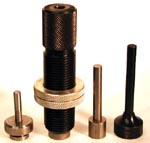
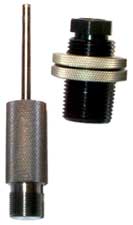 The KIT-224S includes:
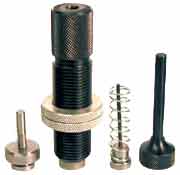
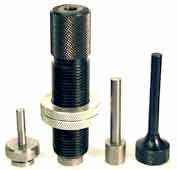
Note: The combination of core swage, core seat and point form is called a "3-die set", catalog number FJFB-3-S. 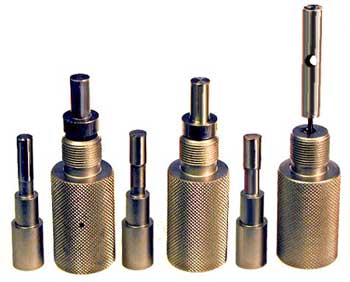
(See PRICE LIST) |
|
How It Works:
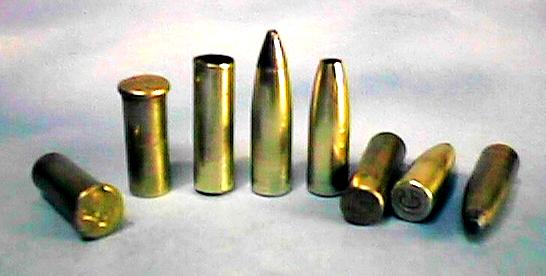
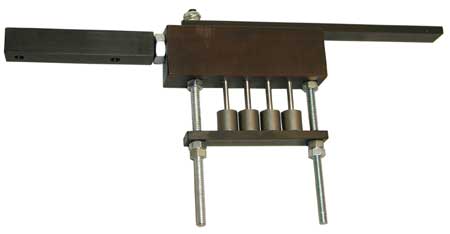
The term ".22" or ".224" covers all of the normal 22 centerfires, which all use 0.224-inch bullets with rare exceptions. For example, the .222, .223, 5.56, 5.7mm, .225, and other cartridge names all use a .224 diameter bullet regardless of what the cartridge is called. A .22 LR case draws out to make a jacket suitable for 45 to 65 grain bullets depending on how much lead you put into it. The heavier weights become lead tip, the lighter ones are open tips. The rim is unfolded and ironed smooth. It isn't "cut off". This is actually how the very first centerfire 22 bullet jackets were made by Harvey Donaldson of the "Donaldson Wasp" fame, before any of us were alive! You can also use regular drawn commercial jackets available from Corbin and other suppliers with the same dies, possibly with a different core seating punch to fit the thicker wall jacket's ID. And once you learn how to make a 224 bullet, the same process and tools with appropriate diameters are used to make any other caliber! Learn one, you have learned it all from .104 to 20mm. Minor variations such as rebated boattails, tip inserts, and making your own tubing or copper strip jackets don't really change how things are done in any major way. An 6mm kit can also be ordered, KIT-243R, which makes 65 grain lead tip bullets using fired 22 cases. A different size jacket maker and swage dies are used but the same size core mold works for either caliber. Longer, heavier jackets can be purchased ready-made from Corbin, or an optional 6mm jacket maker using 22 Magnum cases can be ordered. An extra core seating punch is provided for use with Corbin bullet jackets. Open tip, lead tip, and full metal jacket styles can all be made with the set. Other brands of commercial jackets might require a different, optional core seat punch. Some jacket with thicker walls might require a smaller core swage die or smaller diameter core mold -- always send sample jackets for testing and measurement so the proper size tools can be provided for use with them. For additional weight control with the lower priced reloading press kit, the optional CSW-1-R core swage die can be ordered, which bleeds off surplus lead from the lead cores, leaving a fixed volume of lead on each stroke. The weight can be set by you by the position of the die in the press head. (The core swage is included in the KIT-224S, for the S-press.) 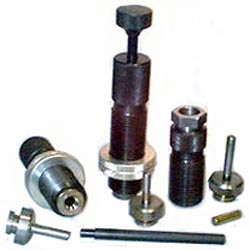
Use any sturdy reloading press that accepts 7/8-14 threaded dies and has a t-slot ram that takes standard RCBS type button shell holders with the Corbin KIT-224R or KIT-243R. Progressive style presses, turrets and other special designs that do not accept a standard RCBS type button shell holder are not suitable. If you do not want to melt scrap lead for your cores, you can instead choose a spool of lead wire (.185 diameter) and a Corbin Core Cutter (PCS-1). Or get both so you can decide what to use depending on the time you have that day! A core mold costs just about the same as two 70,000 grain spools of wire and a core cutter. A single spool of wire makes, on average, about 1,550 bullets. (Subtract jacket weight from desired bullet weight, and divide the answer into 70,000 for number of bullets per spool of wire.) 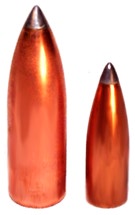 For a high quality, professional looking lead tip, an optional LT-1-R 224 6-S lead tip forming die can be used in a reloading press, or the LT-1-S 224 6-S lead tip die can be ordered for use in the Corbin S-press.
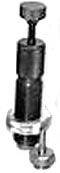 A lead tip finishing die reforms the somewhat blunted lead tip for a professional appearance. You can make lead tips by putting more lead core into the same length of jacket, so that the lead extrudes from the end of the jacket when you form the ogive. Note that a lead tip finishing die is always used AFTER forming the ogive in a point form die. Don't confuse a point former with a lead tip finisher!
To make a lead tip with less weight, put one of the 3/16-inch diameter "bullet balls" into the jacket first, with a lighter core on top. That moves the lead forward, so the same amount will now be available to make lead tips without any extra weight. Bullet balls are available from Corbin in packages of 1000, and are used for both balance and weight control, for making accurate super light bullets, and for making polymer rounded tips. |
Rimfire jackets are only about .010-.012 inches thick, made of 70% copper and 30% zinc. Most commercial jackets are around .018-.022 inches thick, and are made of 5% to 10% zinc with the balance copper. These two facts lower the friction of the rimfire jacket, so that it is actually easier on the barrel than a commercial jacket. Zinc lowers the co-efficient of friction, and the thin jacket engraves easier by the rifling. (Higher copper content alloys do not break up on impact as much as the rimfire cases, so they make better bullets for edible and dangerous game hunting. Rimfire cases tend to break up when they hit the ground, so they make better varmint bullets with far less richochet potential.) Any bullet fouls the bore to some degree. The rimfire jacket generally causes less fouling than commercial jackets, for a couple of reasons. First, it usually has lower surface friction, being thinner and slightly less "gummy" than the softer copper alloy. But it also can't be fired with as high a velocity due to the thinness of the jacket, so it forces the handloader to use less powder, less speed, and therefore causes less fouling than a bullet fired at higher speed. Cases which have been fired in certain guns with sharp, square edged firing pins may in fact have an actual tear or hole in the edge. This will become evident when you unfold the rim, in the rimfire jacket maker die. Just toss out any drawn jackets where you can see an actual hole through the brass. Marlin lever action rifles at one time were notorious for their sharp, rectangular firing pin dents. Even a rather severe tear in the case edge won't cause major problems if you make the cases into bullets and shoot them, but they can cause flyers if the tear is right at the edge of the bullet base. Most of the rimfire cases will simply be dented at the rim, and the dent is pushed back out again when you seat the lead core in the jacket. Remember, in bullet swaging, you'll be applying up to 30,000 psi inside the jacket as you compress the lead core. That's as much pressure, sometimes more, than the powder generates when you pull the trigger! Primer dents are pushed back out again since it didn't take that much pressure to create them in the first place! You can usually see where the dent was, from the slight discoloration of the surface, but it causes no problem and doesn't affect accuracy. Rimfire cases themselves are surprisingly consistent within a given brand. Benchrest matches have been won using sorted Eley 22 LR case jackets in a .222 rifle. The least accuracy would be from assorted brands used to make bullets fired into one group. Even so, a gun that can hold a half minute of angle would usually group about the same as it would with a group fired using assorted commercial jackets. If you sort the headstamps and use the same brand, the groups will usually be comparable to any commercial bullet in the same gun, once you work up the best load for that bullet. The answer to the question would be the same as if asked "Are Sierra bullets accurate?" or "Are Hornady bullets accurate?" Sure, but you have to work up the best load for each in any given gun, and some guns may perform slightly better with one brand than another. The short answer is "Yes! Surprisingly accurate." Yes, there are. Because the jackets are thin, the velocity should be reduced to prevent bullet disintegration in flight. Start loading below 3000 fps, and work up until your bullets start to create one or two flyers out of a group of five shots, then back down until you get the tight groups back. Some guns will handle higher velocity than others with the thin jackets. A general rule of thumb is that the limit in a 1-10 barrel twist is somewhere around 3,200 fps, but many shooters have reported good results at higher velocity. The jackets are thin so the bullets open up quickly or blow up on impact, making great varmint bullets but poor edible game bullets. Of course, because they are thin, they act as if they impact at 4,000 fps even when the speed is only 3,200 fps, saving powder and barrels in the process! The KIT-224R has everything you need except for your press, your supply of empty cases, and your supply of soft scrap lead. Here is what the kit includes:
The weight range with fired 22 LR cases is from about 40 grains (using a Corbin bullet ball to take up space inside the jacket) to about 60 grains (using a lead tip). The open tip, conventional design of bullet without exposed lead would range from about 52 to 55 grains, adjustable by you simply by using more or less length of core lead in the same jacket. If you wish to make a more precise weight than you can cast (or cut from lead wire, if you should choose that option), then you can add the optional CSW-1-R Core Swage. This lets you further refine the precision of the core weight by setting a fixed volume of core and bleeding off any surplus weight over that desired volume. A hole through the external punch extrudes the surplus lead, which you can then snip off the core with a pen knife or a small clipper, removing the variations in volume and weight with it. If you wish to make a factory-finished lead tip on your bullet, rather than having the .081-inch diameter flat tip caused by the ejection pin (which pushes the bullet out of the point forming die), you can get the LT-1-R lead tip forming die. After making a lead tip bullet (simply by using more lead than fits into the jacket), you then gently push the bullet into the LT-1-R die to "clean up", smooth and sharpen the tip so it is uniform and looks like it came from a factory. Do you "need" these accessories? Well, that's up to you. You can make good bullets without them, but you can make better bullets with them. Actually, if you want to make the best possible bullets, you should consider the CSP-1 S-press and the FJFB-3-S 3-die set which fits into it, giving you self ejection of the bullets on the down stroke, eliminating about 2/3 of the time involved in handling the bullets and ejecting them from the -R type dies. The -S type dies fit into the ram of the CSP-1 press, so the internal punch is operated when you stroke the ram up and down. You would not need to pick up a mallet and use a knock-out rod or catch the bullet as it falls from the die, since the die faces upward. It is a big step up in production speed, ease of use, and of course the alignment of the hand-built swaging press is usually far better than a mass-produced reloading press. The only drawback is the higher cost. However, you can make a good bullet either way. Yes, just add LW-10 .185 lead wire and the PCS-1 .185 core cutter. This would give you the speed and safety of cutting lead wire instead of melting lead, but the CM-4a core mold included in the kit gives you a backup, should you run out of lead wire or should it be hard to find (Corbin keeps it in stock but it is good to be prepared for any event). Commercial bullet jackets can also be used, but you would need to get a core seating punch which is a proper fit into the particular jacket, at whatever length of core you wish to use. Commercial jackets typically are tapered in wall thickness. They get thicker toward the base. So for the core seating external punch to be a good fit for your desired core weight, the punch has to be sized so it seals pressure inside the jacket you use, at the point where your core will be seated. Corbin provides commercial 224 jackets of high quality, and can provide a standard punch to fit them at the more commonly used length of core. Just order the jacket and a PUNCH-R 224 CS EXTERNAL OT for J-22-705 jacket. We'll know exactly what you need from that. If you get your jackets elsewhere, we will need a couple of samples and a sample length of core to fit them, in the weight you plan to use. Then we can make a punch to fit properly for that jacket and core length. Everything else remains the same in the kit. Only the diameter of the core seating punch is changed (by providing another, optional punch). |
How to Swage .224 Bullets
|
|
Corbin Manufacturing & Supply, Inc.
Fax 24-hrs: 541-826-8669 Website: http://www.swage.com E-mail: sales@corbins.com |
| Home Page | Price List | E-Mail Sales | Site Map | New Products | Auto Q&A | Terminology |
| Retirement | Specials | Real Estate | Software | How to swage | Classified Ads | Feedback |